AI adoption is often sold as a productivity story.
Write faster. Code faster. Summarize faster. Analyze faster. Ship faster.
That story is not wrong. But it is incomplete.
Anthropic’s Economic Index survey of 80,508 Claude users shows that people are experiencing meaningful productivity gains from AI. The average productivity rating was 5.1 on a seven-point scale, which Anthropic describes as “substantially more productive.” The most common benefit was not only speed. It was expanded scope: 48% of users who explicitly mentioned productivity effects said AI helped them do new kinds of work, while 40% emphasized speed. (Anthropic, 2026)
That matters because AI is not simply helping people complete existing tasks faster. It is changing what people believe they are capable of doing.
But the same report also reveals a deeper tension. Workers in more AI-exposed occupations expressed more concern about job displacement. Anthropic found that for every 10-percentage-point increase in observed AI exposure, perceived job threat increased by 1.3 percentage points. People in the top 25% of exposure mentioned this worry three times as often as those in the bottom 25%, and early-career respondents were much more likely than senior workers to express displacement concern. (Anthropic, 2026)
That is the adoption paradox.
AI can make people more productive and more anxious at the same time.
And that is why sustainable AI adoption requires more than tool access, training sessions, and productivity dashboards. It requires leadership.
The Real Adoption Problem Is Not Usage
Many organizations are treating AI adoption like a normal software rollout.
Buy the licenses. Approve the tools. Run a training session. Track usage. Celebrate efficiency.
That may create activity, but it does not guarantee durable adoption.
The adoption question cannot stop at, “Are people using AI?” It has to go one step further: “Do people trust what AI usage means for their future?”
A worker can use AI every day and still distrust the strategy behind it. A team can produce faster outputs and still worry that the real goal is headcount reduction. An organization can show impressive pilot results and still fail to change how work actually gets done.
This is where AI programs can stall.
Not because the tools are weak.
They stall because employees are quietly asking a different question:
What happens after we become more productive?
If the answer is unclear, people will fill in the blanks themselves. Some may assume AI is about cost-cutting. Some may hide how much time they are saving. Some may experiment privately instead of through approved channels. Some may comply on the surface while resisting deeper workflow changes.
That is not irrational resistance.
It is a trust gap.
Productivity Without Trust Feels Like Extraction
The most important leadership question around AI productivity is not simply, “How much time did we save?”
It is, “Who benefits from the time saved?”
Anthropic’s report makes this tension visible. Among respondents who identified a beneficiary of AI productivity gains, most said the gains flowed to themselves through faster tasks, expanded scope, or freed-up time. But 10% said employers or clients were asking for and receiving more work. The career-stage difference is especially important: only 60% of early-career workers indicated that they personally benefited from AI, compared with 80% of senior professionals. (Anthropic, 2026)
That finding stood out to me because inside organizations, productivity gains can feel like one of two very different things.
They can feel like enablement:
“I can do better work, learn faster, and spend more time on judgment.”
Or they can feel like extraction:
“I am expected to produce more, faster, with less support, while my role becomes less secure.”
The same AI tool can create either experience.
The difference is leadership.
If leaders only talk about efficiency, employees hear pressure. If leaders only talk about automation, employees hear replacement. If leaders say “AI will augment work” but never explain what that means in practice, employees may treat the message as corporate fog.
Trust requires specificity.
People need to understand why AI is being introduced, what work it is meant to improve, what decisions remain human-owned, how roles will evolve, and how productivity gains will be used.
Without that, productivity becomes a threat signal.
The Hidden Risk: Breaking the Talent Pipeline
There is another risk that deserves more attention: AI could weaken the very talent pipeline organizations depend on.
A common assumption is starting to appear in technology conversations: if AI can perform many junior-level tasks, maybe companies do not need as many junior employees.
On paper, that looks efficient.
AI can draft code. AI can summarize meetings. AI can generate test cases. AI can write documentation. AI can analyze logs. AI can produce first-pass research.
These are also the tasks many early-career workers have historically used to learn.
So leaders may be tempted to ask: why hire as many juniors if AI can do much of the junior work?
But that question creates a deeper problem.
Senior engineers, architects, technology managers, and domain experts do not appear out of nowhere. They are developed through years of doing real work: writing imperfect code, debugging production issues, sitting in design reviews, asking basic questions, receiving feedback, and learning how systems behave under pressure.
If organizations remove too much of that early-career work, they may save money in the short term while weakening their future bench.
This matters because demand for technical talent is not disappearing. The U.S. Bureau of Labor Statistics projects employment for software developers, quality assurance analysts, and testers to grow 15% from 2024 to 2034, with about 129,200 openings projected each year on average. Many of those openings are expected to come from workers transferring occupations or exiting the labor force, including retirement. (Bureau of Labor Statistics, U.S. Department of Labor, 2025)
So here is the uncomfortable question:
If fewer young workers are hired and trained, and senior engineers eventually retire, who bridges the gap?
AI can assist the work, but it does not automatically create judgment.
It can generate code, but it does not teach someone why a design is fragile. It can summarize an incident, but it does not build the intuition that comes from being accountable during one. It can create documentation, but it does not develop the communication judgment needed to explain tradeoffs to business leaders. It can generate a test, but it does not know which business failure the test is supposed to prevent.
That is learned through apprenticeship, exposure, and responsibility.
The goal should not be to eliminate junior work.
The goal should be to redesign it.
Junior Work Should Evolve, Not Disappear
The right question is not:
Can AI do this junior task?
The more useful question is:
What does this task teach, and how do we preserve that learning even if AI accelerates the output?
That question changes the AI adoption conversation.
If AI writes the first version of a unit test, the junior engineer should still explain the edge cases, identify missing scenarios, and validate whether the test protects the right behavior.
If AI summarizes a production incident, the junior engineer should still walk through the timeline, explain the failure mode, and identify where observability, architecture, or process failed.
If AI generates code, the junior engineer should still explain the assumptions, dependencies, tradeoffs, and maintainability risks.
If AI drafts a requirements summary, the analyst should still validate whether the summary reflects the real business need, not just the words in the meeting transcript.
This is how AI becomes a learning accelerator instead of a learning replacement.
In an AI-enabled workplace, the junior role should not disappear. It should evolve from producing first drafts to learning how to question, validate, and improve them.
That requires managers to coach differently. It requires senior employees to review differently. It requires organizations to value reasoning, validation, and judgment — not just output volume.
Faster Work Is Not Always Better Work
Another reason productivity gains alone will not make AI adoption sustainable is that many organizations are adding AI on top of workflows that already do not work well.
If decision rights are unclear, AI will not fix that. If handoffs are messy, AI may create more artifacts without improving accountability. If teams are overloaded, AI may simply raise expectations. If managers do not know how to evaluate AI-assisted work, employees will not know what “good” looks like.
This is where workflow redesign becomes essential.
McKinsey’s State of AI research found that, among 25 organizational attributes tested, workflow redesign had the biggest effect on an organization’s ability to see EBIT impact from generative AI. Yet only 21% of respondents whose organizations use gen AI said their organizations had fundamentally redesigned at least some workflows. (Singla et al., 2025)
That is the gap.
AI usage is spreading, but operating models are lagging.
The question should not be, “Where can we add AI?”
The stronger question is, “How should this work happen now that AI is available?”
The first question leads to tool adoption.
The second leads to transformation.
A Practical Playbook for AI Adoption That Sticks
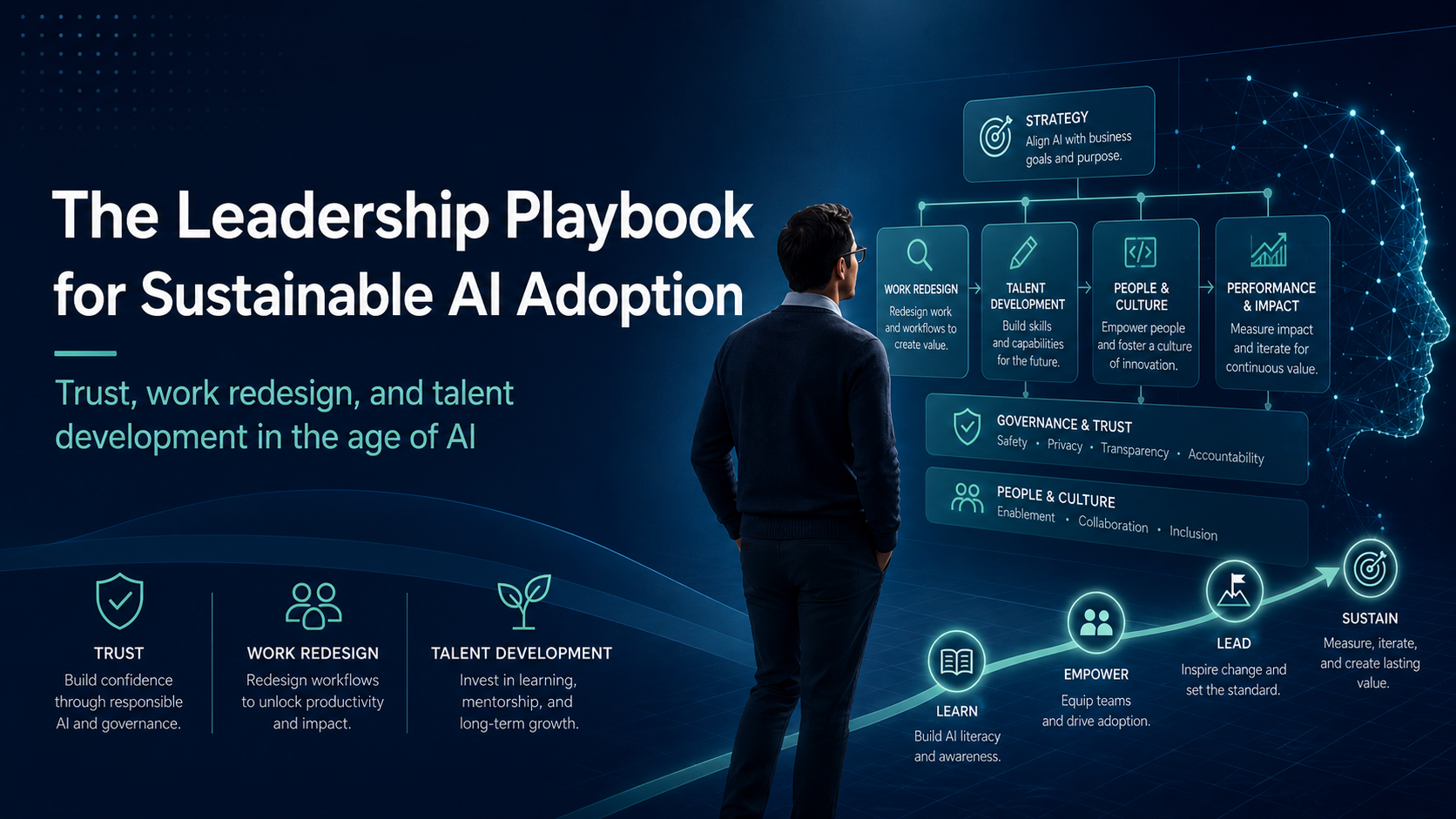
For AI adoption to last, leaders need to move from tool rollout to work redesign.
A practical playbook starts with six questions.
1. What is the purpose?
Do not introduce AI with vague language like, “We want everyone to be more productive.”
Be specific.
Are we trying to reduce manual documentation? Improve quality checks? Speed up research? Reduce operational toil? Improve customer response time? Create more capacity for strategic work?
When the purpose is unclear, employees often assume the purpose is cost reduction.
A clearer message sounds like this:
“We are using AI to reduce repetitive documentation and analysis so teams can spend more time on design quality, customer impact, and risk reduction.”
That gives people a reason to trust the change.
2. What are the boundaries?
Employees need to know where AI should and should not be used.
AI can draft the first version, but a human owns the final judgment. AI can summarize incidents, but humans validate root cause. AI can generate test ideas, but engineers decide coverage. AI can support decisions, but it should not silently make accountable decisions.
Boundaries build trust because they make human judgment visible.
3. How does the workflow change?
Do not just insert AI into the old process.
Map the workflow and ask: which steps are repetitive, which steps require judgment, which approvals still matter, which handoffs can be removed, where does AI introduce new risk, and where do we need human review?
This turns AI from a side tool into part of the operating model.
4. What does good work look like now?
AI changes output volume, so leaders need to update expectations.
If employees can produce more drafts, summaries, and analysis, then quality cannot be measured only by speed or quantity.
Good work should increasingly mean better judgment, stronger validation, clearer framing, better risk awareness, and stronger communication.
If managers reward only speed, employees will optimize for speed. If managers reward judgment, employees will use AI more responsibly.
5. How do we protect apprenticeship?
Every team should identify the work that develops future talent.
What tasks teach system knowledge? What tasks build debugging intuition? What tasks develop customer empathy? What tasks teach risk judgment? What tasks help junior employees understand tradeoffs?
Then redesign those tasks with AI, instead of removing them.
The output can be accelerated.
The learning cannot be skipped.
6. Who benefits from the productivity gains?
This may be the most important trust-building question.
When AI saves time, what happens to that time?
Does it become more work? Does it create learning time? Does it reduce burnout? Does it improve customer experience? Does it create room for higher-value work? Does it become a headcount reduction argument?
Leaders do not need to promise that nothing will ever change. That would not be credible.
But they do need to be honest about intent.
Trust grows when employees believe productivity gains will be shared, not just extracted.
The Leadership Shift
The old AI adoption question was:
How do we get people to use the tool?
The leadership question now is:
How do we redesign work so people trust the role AI plays in it?
That shift matters because AI is not a normal enterprise application. It touches knowledge work, career paths, decision-making, team structure, and the relationship between effort and value.
Anthropic’s Economic Index shows the tension clearly: people are experiencing real productivity gains, but those gains also create real anxiety, especially in roles and career stages most exposed to AI-driven change. Respondents experiencing the largest speedups were also the most nervous about AI’s job impacts. (Anthropic, 2026)
That should be a wake-up call for leaders.
Productivity is the entry point for AI adoption. It is not the finish line.
The real measure of success is not whether employees can produce more with AI. It is whether the organization can turn those gains into better work, clearer roles, stronger judgment, and a healthier talent pipeline.
AI can make work faster.
But only leadership can make faster feel better, safer, and worth adopting.
References
Anthropic. (2026, April 22). What 81,000 people told us about the economics of AI. https://www.anthropic.com/research/81k-economics
Bureau of Labor Statistics, U.S. Department of Labor. (2025, August 28). Software developers, quality assurance analysts, and testers. Occupational Outlook Handbook. https://www.bls.gov/ooh/computer-and-information-technology/software-developers.htm
Singla, A., Sukharevsky, A., Yee, L., Chui, M., & Hall, B. (2025, March 12). The state of AI: How organizations are rewiring to capture value. McKinsey & Company. https://www.mckinsey.com/capabilities/quantumblack/our-insights/the-state-of-ai-how-organizations-are-rewiring-to-capture-value