Jev has been hard to miss this week. I saw the usual mix of excitement, big claims, benchmarks, and an equal amount of skepticism. What stood out to me were the numbers around low latency and cost, but also something more basic: Jev is not trying to generate an answer in the way we have become used to with LLMs. It is trying to make a decision which reminded me of my amateur hour claude code model-router skill i had written a few months ago.
I am naturally skeptical when something gets this much attention this quickly, especially in AI. But I was definitely drawn in enough to dig deeper.
And somewhere along the way, Fatboy Slim came to mind. Maybe he was ahead of his time when he called an album Halfway Between the Gutter and the Stars. Jev seems to occupy an interesting middle ground of its own—somewhere between hard-coded software rules and asking a large reasoning model to figure everything out. And for a model built around fast System One decisions, “Right Here, Right Now” feels oddly appropriate too. Jokes aside, that middle ground is what interested me.
I started looking at Jev from two perspectives. As a developer, I wanted to understand what it actually does differently, where the performance benefits come from, and what I could build with it. As a technology leader, I wanted to know where something like this belongs in an architecture, where it should not be used, and whether it solves a real problem or simply adds another model to manage.
As i dug in further through frequent breaks to hear about the Nor’easter taking over coastal new jersey. The Jev-versus-LLM debate i noticed from linkedin posts over the week started to feel misplaced. What i found interesting was the question around how many things are we asking LLMs to do today that never needed generation or deep reasoning in the first place?
What is Jev trying to do?
Jev is TypeSafe AI’s first System One Model. Instead of generating free-form text, you provide some state and ask bounded questions. Jev returns typed decisions and probabilities. TypeSafe supports primitives such as choices, scores, and yes/no judgments (TypeSafe AI, 2026).
Take a customer message:
“I was charged twice this month. I already contacted support and if this happens again I’m cancelling.”
An LLM could analyze the message, explain the customer’s frustration, write a response, summarize the issue, and return some JSON telling my application what to do.
But perhaps my software only needs three things:
team      → billing
urgency   → high
churnRisk → yes
Jev is designed around that narrower problem. The model makes the fuzzy judgment. My application still controls what happens with it.
System One, System Two, and how we got here
TypeSafe borrows the System One terminology from the familiar System 1/System 2 idea: fast judgment versus slower, deliberate reasoning. I would treat it as an analogy rather than a literal model of either human cognition or AI. There are plenty of problems where I want deliberate reasoning. If I ask a model to review an incident, work through conflicting evidence, and suggest a root cause, a reasoning model makes sense.
But I probably do not need that same machinery to decide whether the incident should be routed to the database team.
The training approaches tell a similar story. RLHF, Reinforcement Learning from Human Feedback, helped models learn what responses people prefer. RLVR, Reinforcement Learning with Verifiable Rewards, works particularly well when we can objectively check an outcome, such as running tests against generated code.
TypeSafe calls its approach RLCD: Reinforcement Learning for Calibrated Decisions. The aim is different again. Instead of optimizing primarily for a generated response, it is optimizing for bounded decisions and useful probabilities (TypeSafe AI, 2026).
I would not look at RLHF, RLVR, and RLCD as replacements for one another. They are useful for different kinds of problems.
Why the speed matters
TypeSafe’s own benchmarks report some very large improvements in latency and cost, including gains as high as 193.6x in speed and 444.6x in cost on some workflows. TypeSafe also says those numbers are toward the higher end of what it expects in practice, so I would not build the argument around the multiplier itself (TypeSafe AI, 2026).
Independent testing is more useful. Across several experiments, Jev has generally shown decision latency in the hundreds of milliseconds rather than the seconds we often see when asking a generative model to reason and produce an answer. OpenRouter saw this pattern in a support-triage experiment: Jev could make the bounded routing decisions much faster and cheaper, while an LLM was still useful when it came time to actually generate the response (OpenRouter, 2026).
Think about an agent. During one task it might ask: Is this result relevant? Which tool should I call? Is this action risky? Should I retry? Does this need review? Did the previous step satisfy the requirement?
We can send every one of those questions through an LLM. But if each decision takes another second or two, that overhead adds up quickly. If some of those decisions can instead happen in a few hundred milliseconds, the overall agent starts to look different.
At the same time, cheap inference is not an excuse to put AI everywhere. If something can reliably be expressed as an if statement, I still want the if statement.
Isn’t this just classification?
This was one of my first reactions too.
Classification is obviously not new. BERT-style models, fine-tuned classifiers, rerankers, zero-shot classification, and constrained LLM outputs already cover a lot of this territory.
So I wonder whether a general decision model with typed outputs, useful probabilities, parallel questions, and a developer-friendly interface gives us a practical option between hard-coded rules and general-purpose LLMs. If I have a mature classifier with good labeled data that already solves my problem, I have no reason to throw it away. If the rule is deterministic, I want code.
Where Jev starts to interest me is when the input is messy but the answer is bounded.
I think of these as fuzzy if statements.
Is this request risky? Is this document relevant? Which of these four teams owns the problem? Does this output require human review?
I know what my software will do once it gets the answer. The fuzzy part is interpreting the input.
“no hallucinations”?
If I give Jev four choices, it cannot invent a fifth. That removes an important class of failures when a model sits inside automated software. But Jev can still select the wrong one.
A model returning LOW when the correct answer is CRITICAL is still wrong, even if LOW was a perfectly valid output.
hence, constrained output removes one form of hallucination; it does not remove model error.
That also means confidence has to be tested against the workload where the model will actually run. A 90% score is useful only if I understand what that confidence means for my data and my consequences.
A quick note on Laya
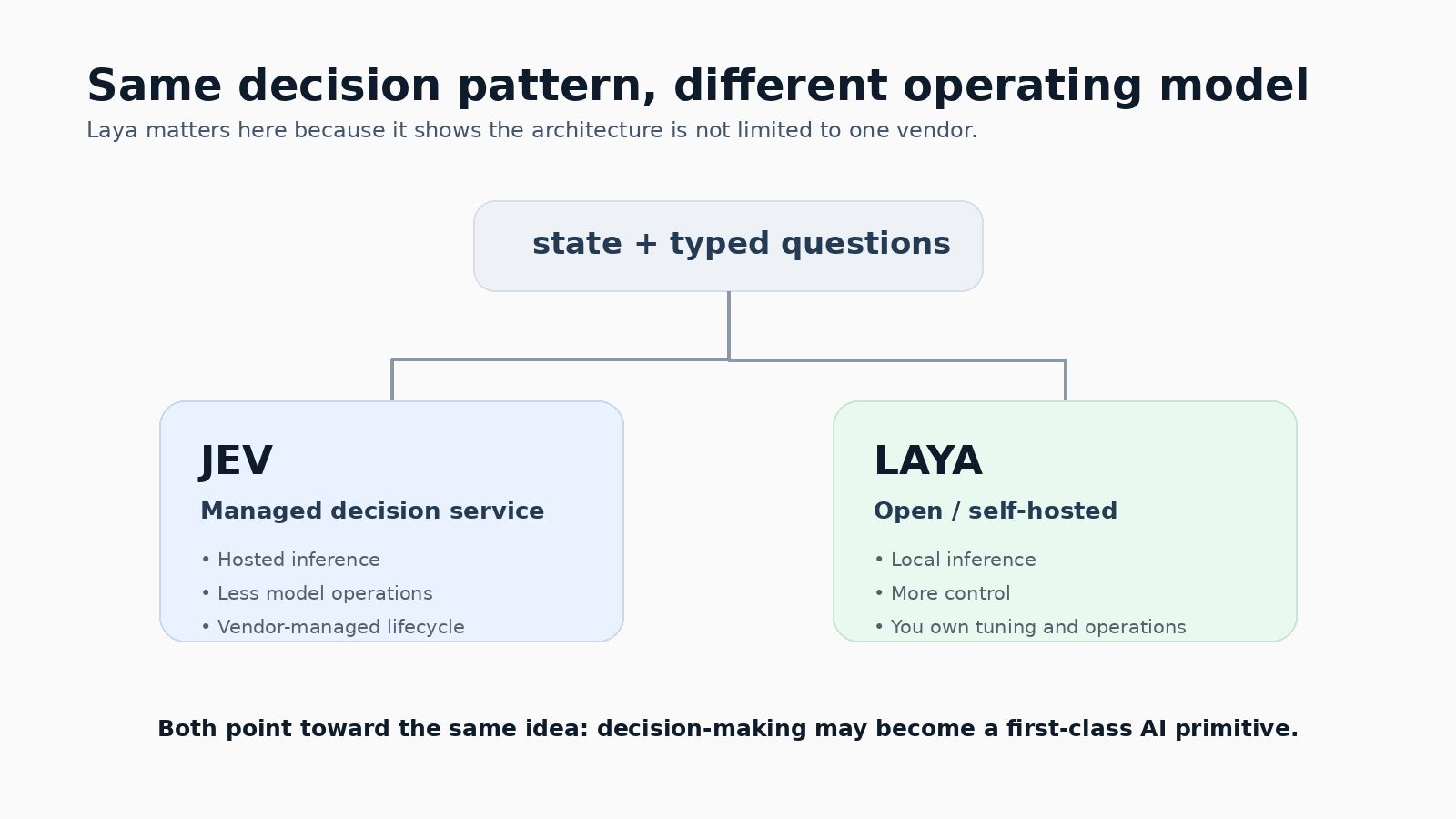
While looking into Jev, I also came across Laya, an open-weight model built around a similar System One decision architecture.
I am not going to turn this post into a Jev-versus-Laya comparison. Laya deserves its own exploration because self-hosting, open weights, tuning, performance, and the operational tradeoffs could easily become another post.
For this discussion, Laya matters for one reason: it shows that the same architectural idea can exist outside one vendor.
Jev approaches the problem as a managed service. Laya shows the same general pattern can be implemented locally with open weights. That makes me more interested in System One models as a category than in Jev as a standalone product.
Where I would use Jev
The best use I see is not handing Jev an entire workflow. It is finding the part of the workflow where normal software runs into a fuzzy judgment.
For an engineering agent, for example, I would not ask:
Should I execute this production action?
That gives the model too much responsibility.
I might ask whether the action is destructive, whether it appears to affect production, whether rollback information exists, and whether the user’s request actually supports the action.
Those are judgments. My code still owns the policy. A destructive production change without approval can simply remain blocked regardless of the model score.
I would explore Jev for routing, relevance, prioritization, risk signals, agent review gates, model selection, and similar high-volume decisions.
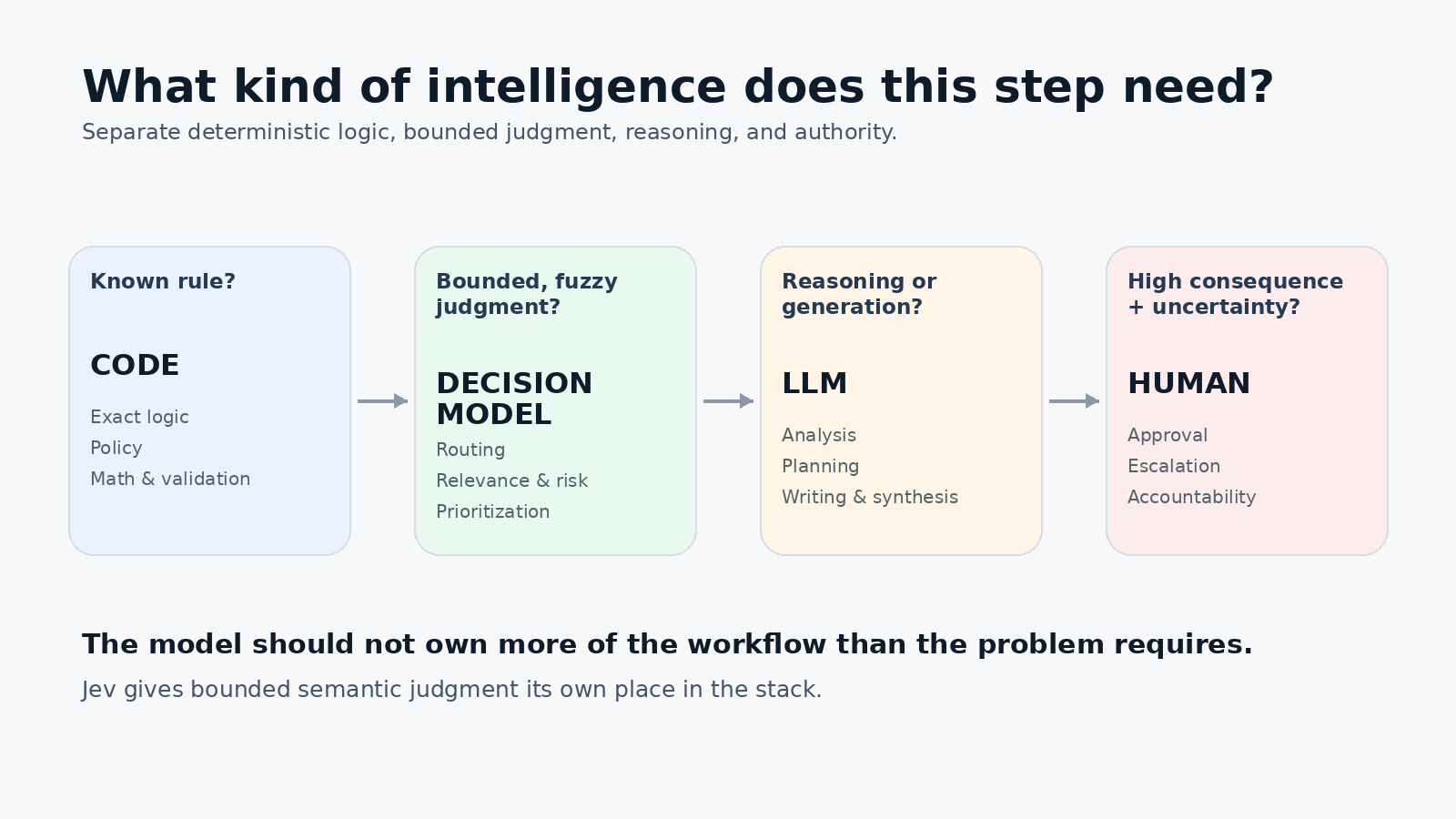
I would not use it for exact rules, arithmetic, writing, long-form analysis, code generation, architecture design, or anything where the value comes from reasoning and generation. I would also not make a probabilistic model the final authority for an irreversible action.
What I take away from it
As a developer, Jev gives me another question to ask before I reach for an LLM: what does this step actually need the model to produce?
Sometimes the answer is prose, code, synthesis, or reasoning. Use the LLM. Sometimes it is one bounded judgment over messy input. A decision model may be a better fit. Sometimes there is no reason to use a model at all.
As a technology leader, the part I care about is keeping those boundaries visible. If decision models become fast and inexpensive, it becomes easy to bury probabilistic decisions throughout an application. I would want to know where they exist, how their thresholds were tested, what happens when they are uncertain, and which decisions remain deterministic by design.
While this is less exciting than a benchmark. It is the part that determines whether these systems hold up in production.
Where I think this goes
I do not see Jev replacing LLMs. I see it as another sign that the AI stack is becoming more specialized. Code handles what we know. Decision models handle certain bounded judgments. Reasoning models handle the harder problems. Humans stay involved where consequence and uncertainty make that necessary.
Whether those eventually remain separate models or become different modes of the same model is harder to know.
For now, Jev made me reconsider one assumption I have made plenty of times myself: if a piece of software needs something intelligent, call an LLM.
I think i would change that to:
What kind of intelligence does this particular step actually need?
That is what I want to test in Part 2. I plan to take the same set of engineering decisions and implement them with deterministic code, Jev, Laya, an LLM, and a hybrid approach—not to prove which model wins, but to see where each one actually belongs and how much of the work we currently send to an LLM needed an LLM at all.
References
OpenRouter. (2026). Jev vs. LLM: When to use each. OpenRouter Blog. https://openrouter.ai/blog/tutorials/jev-vs-llm-when-to-use-each/
TypeSafe AI. (2026). Introducing System One models and Jev. TypeSafe AI Blog. https://typesafe.ai/blog/introducing-system-one-models-and-jev