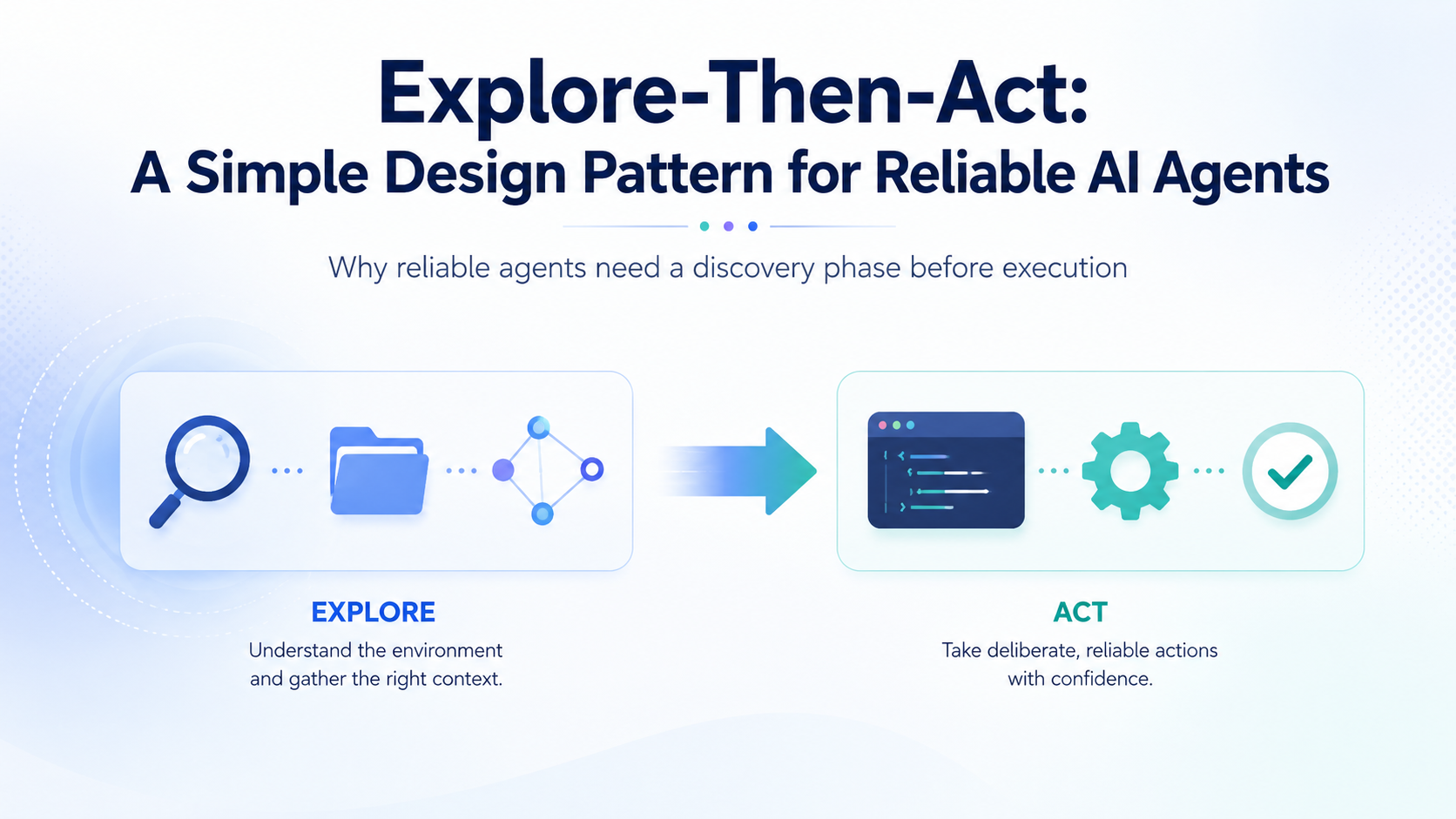
AI agents are most reliable when they understand the environment before taking action.
When an agent starts executing too quickly, it can make reasonable-looking decisions based on incomplete context.
That is the core lesson from Look Before You Leap: Autonomous Exploration for LLM Agents (Ye et al., 2026). The paper argues that many LLM agents fail in unfamiliar environments because they suffer from premature exploitation: they act on prior patterns before acquiring enough environment-specific knowledge. Instead of first discovering the rules, tools, objects, constraints, and affordances of the environment, they rush into action.
For engineering leaders building practical AI systems, this is more than a research idea. It is an architecture pattern.
In enterprise environments, agents rarely operate in clean, static, well-documented worlds. They operate inside messy codebases, fragmented documentation, Jira tickets, cloud consoles, internal APIs, CI/CD pipelines, audit evidence folders, production logs, and SaaS workflows. In those environments, “just do the task” is not a safe instruction. A reliable agent needs a deliberate discovery phase before it makes changes.
The practical takeaway is simple:
Do not ask the agent to solve first.
Ask the agent to explore first.
The Problem: Agents Often Act Too Soon
Most current agent workflows are designed around task completion. Give the agent a goal, give it some tools, let it reason, let it act, observe what happens, and continue. That works well in some bounded cases. But in unfamiliar environments, task-focused behavior can become brittle.
Ye et al. (2026) describe two recurring failure modes.
First, an agent may lack a clear starting point. It may wander aimlessly or confidently follow a poorly informed plan. Second, the agent may misunderstand environment-specific semantics, such as tool arguments, UI affordances, action preconditions, or hidden constraints. These mistakes compound over multiple steps and lead to failure.
This should feel familiar to anyone who has watched an AI coding assistant modify the wrong file, generate tests that do not match the repo’s conventions, call a tool with the wrong arguments, or assume an API behaves the way a typical API behaves rather than how this specific API behaves.
The paper’s diagnosis is important: task success alone does not necessarily teach exploration. In fact, the authors find that task-oriented reinforcement learning can produce narrow and repetitive behaviors. In their Table 1, Qwen3-4B drops from 28.5% average Exploration Checkpoint Coverage to 18.8% after task-oriented GRPO training (Ye et al., 2026). That is a crucial enterprise lesson. Optimizing agents only for completion can make them faster at acting, but not necessarily better at understanding.
The Core Idea: Exploration Before Execution
The paper separates exploration from task execution.
In a traditional task setting, the agent receives a goal and each action is directed toward maximizing task reward. In contrast, autonomous exploration is defined as a proactive information-gathering process that operates independently of a specific task goal. The agent probes the environment to build knowledge about state layout, available items, tool behavior, action semantics, and hidden constraints. After exploration, the agent synthesizes this into a grounded knowledge summary.
To measure this, the authors introduce Exploration Checkpoint Coverage, or ECC. ECC measures whether the agent discovered important checkpoints in the environment. These checkpoints can include reachable locations, key objects, valid interaction targets, functional states, action-relevant affordances, or environment-specific constraints.
Then they introduce Explore-then-Act:
- Give the agent an exploration budget.
- Let it inspect the environment without trying to complete the task yet.
- Summarize the discovered knowledge.
- Inject that knowledge into the task-solving phase.
- Execute the task using environment-grounded context.
This is powerful because it turns exploration into a first-class capability, not an accidental byproduct of action.
The paper evaluates this idea across ALFWorld, ScienceWorld, TextCraft, and a challenging ALFWorld variant. These environments test different forms of exploration: household navigation and object manipulation, scientific rule discovery, and multi-step resource crafting under hidden recipe structures (Ye et al., 2026).
The result is nuanced. Explore-then-Act is not magic by itself. Poor exploration can actually hurt performance because it adds noisy or incomplete context. But when agents are trained with explicit exploration-aware objectives, Explore-then-Act consistently improves performance. In Table 2, the paper reports that exploration-aware interleaved training improves average task success under Explore-then-Act for both Qwen2.5-7B and Qwen3-4B across the tested environments (Ye et al., 2026).
That nuance matters. The lesson is not “always add more context.” The lesson is:
Make the agent discover the right context before acting.
How Explore-Then-Act Differs From ReAct
ReAct was a major step forward for agent design. It combines reasoning and acting in an interleaved loop: the model reasons, takes an action, observes the result, and continues. The original ReAct work showed that reasoning traces help agents plan, track progress, update decisions, and handle exceptions, while actions let them interact with tools or environments to gather information (Yao et al., 2023).
A simplified ReAct loop looks like this:
Thought → Action → Observation → Thought → Action → ObservationExplore-then-Act changes the structure.
Instead of mixing reasoning, action, and discovery under the immediate pressure of the task goal, Explore-then-Act creates a dedicated discovery phase first.
Explore → Build Environment Map → Validate Coverage → Plan → ActThe difference is subtle but important.
ReAct asks:
What should I do next to solve this task?
Explore-then-Act first asks:
What do I need to understand about this environment before solving the task?
In the paper’s language, ReAct-style direct execution keeps the agent under a unified goal-directed policy. Explore-then-Act explicitly allocates a preliminary interaction budget for resolving environmental uncertainty. After the exploration phase, the agent creates a grounded knowledge summary that captures state layouts, object affordances, action preconditions, discovered constraints, and failure cases (Ye et al., 2026).
For enterprise systems, that difference is huge.
A ReAct-style coding agent might begin by editing files after a few observations. An Explore-then-Act coding agent first maps the repo, identifies build tools, test frameworks, dependency boundaries, existing patterns, and risky files. Only then does it propose a patch.
A ReAct-style audit agent might start generating evidence. An Explore-then-Act audit agent first identifies the control objective, evidence source, data owner, reporting period, completeness checks, approval workflow, and exception path.
A ReAct-style operations agent might start remediation. An Explore-then-Act operations agent first inspects logs, alerts, deployment history, service dependencies, blast radius, rollback paths, and ownership.
That is the practical shift: from task-first autonomy to environment-grounded autonomy.
Evidence From the Paper: Exploration Is Measurable
One of the best parts of the paper is that it does not treat exploration as a vague behavior. It makes exploration measurable.
In Table 1, the authors place agents into environments without task instructions and ask them to freely explore within a 100-step budget. They then measure how much of the environment’s exploration checkpoint set was covered. The results show a wide gap between models. For example, the paper reports low average ECC scores for several open-source models, while frontier proprietary models perform better. It also reports that task-oriented GRPO can reduce ECC, reinforcing the point that task-only optimization may weaken exploration behavior (Ye et al., 2026).
The paper also shows why naive exploration is not enough. The authors report that shallow or ineffective exploration can degrade downstream performance. This is the enterprise caution: giving an agent more observations does not guarantee better decisions. The observations must be relevant, structured, and connected to the task.
In Table 2, the authors compare Direct Execution with Explore-then-Act across multiple models and training strategies. Zero-shot ReAct does not automatically benefit from Explore-then-Act. In some cases, it performs slightly worse. But exploration-aware interleaved training improves both direct task execution and Explore-then-Act performance. That suggests the real capability is not merely adding a pre-step. The agent must learn how to explore productively.
This is the most important practical interpretation:
Exploration is not wandering.
Exploration is disciplined discovery.
Real-World Evidence Beyond the Paper
The broader agent benchmark landscape points in the same direction. Realistic agents struggle not because they cannot produce fluent responses, but because they must operate in long-horizon, stateful, tool-rich environments.
SWE-bench evaluates models on real GitHub issues and corresponding pull requests. A model is given a codebase and an issue, then must edit the codebase to resolve the problem. The original benchmark contains 2,294 software engineering problems from 12 popular Python repositories, and resolving issues frequently requires understanding changes across multiple functions, classes, and files (Jimenez et al., 2024). This is exactly the kind of scenario where premature action fails.
WebArena evaluates agents in realistic web environments across e-commerce, social forums, software collaboration, and content management. The WebArena authors report a large gap between humans and agents, with their best GPT-4-based agent achieving 14.41% end-to-end task success compared with 78.24% human performance (Zhou et al., 2023). That gap reinforces the point that agents struggle when they must navigate realistic environments with state, tools, and long-horizon dependencies.
OSWorld extends the challenge to real computer environments across operating systems such as Ubuntu, Windows, and macOS. It is designed for open-ended computer tasks involving arbitrary applications, task setup, execution-based evaluation, and interactive learning (Xie et al., 2024).
Taken together, these examples show why Explore-then-Act matters. Real work is not a single prompt. Real work is a landscape.
A Practical Enterprise Example: AI Agent for Java Test Generation
Imagine a developer asks an AI coding agent:
Generate unit and integration tests for the
CustomerRiskService.
A direct-execution agent may immediately open the service file and start producing tests. Sometimes that works. In a large enterprise codebase, it often does not.
The agent may miss that the repo uses Java 21 but has legacy test conventions. It may use Mockito incorrectly. It may generate tests that bypass required fixtures. It may ignore integration test containers. It may fail to notice that certain downstream clients are mocked through shared test utilities. It may write tests that pass locally but fail in CI.
An Explore-then-Act version of the same workflow would look different.
Phase 1: Explore
The agent gets a read-only discovery budget.
Explore the repository before writing any code.

Discover:
- Java version and build tool
- test frameworks and conventions
- existing tests for similar services
- mocking patterns
- test data builders or fixtures
- package naming conventions
- CI test commands
- external dependencies used by CustomerRiskService
- risky paths such as database writes, remote clients, or security-sensitive logic

Do not modify files yet.
Phase 2: Produce an Environment Map
The agent must summarize what it found.
Environment Map

Repo:
- Java 21 Spring Boot service
- Maven build
- Tests use JUnit 5, Mockito, AssertJ
- Integration tests use @SpringBootTest and Testcontainers

Target:
- CustomerRiskService
- Depends on RiskScoreClient, CustomerProfileRepository, and PolicyRulesEngine

Existing patterns:
- Unit tests use MockitoExtension
- Test data is created through CustomerTestDataFactory
- External clients are mocked through shared fixtures
- CI command: mvn verify

Risks:
- RiskScoreClient timeout behavior is not documented
- CustomerProfileRepository has side effects in integration tests
- No existing test covers high-risk customer override logic

Recommended plan:
- Generate unit tests for deterministic policy rules
- Generate integration tests only for repository-backed scenarios
- Do not test timeout behavior until RiskScoreClient contract is confirmed
Phase 3: Apply an Exploration Coverage Gate
Before acting, the workflow checks whether the agent discovered enough.
Required exploration checkpoints:
✅ Build tool identified
✅ Java version identified
✅ Test framework identified
✅ Existing test patterns found
✅ Similar tests inspected
✅ Dependencies mapped
✅ Safe test command identified
✅ Risky side effects identified
⚠️ External timeout contract unknown
Phase 4: Act
Now the agent can generate tests, but its actions are grounded in actual repo knowledge.
This is the enterprise version of ECC. You do not need a perfect academic checkpoint system on day one. You need practical coverage checks that force the agent to look around before changing things.
The Architecture Pattern
The pattern is simple enough to institutionalize:
Discovery Budget
→ Environment Map
→ Exploration Coverage Gate
→ Execution Plan
→ Controlled Action
→ Evidence Log
Each stage has a purpose.
The discovery budget prevents the agent from acting too early. The environment map turns hidden context into an explicit artifact. The coverage gate checks whether the agent discovered the minimum necessary facts. The execution plan makes the intended action reviewable. The controlled action limits blast radius. The evidence log makes the workflow auditable.
This design is especially important in regulated environments. In banking, healthcare, insurance, or other controlled industries, the question is not only:
Did the agent complete the task?
It is also:
Did the agent understand the control environment before it acted?
The Responsibility of Engineering Leaders
Engineering leaders should not treat this as a prompt-writing trick. This is an operating model issue.
If leaders only reward speed, developers will use agents to move faster without necessarily improving reliability. If leaders only count generated code, teams will optimize for output volume. But if leaders require discovery artifacts, test evidence, environment maps, and controlled execution, teams will learn to use agents as disciplined engineering partners.
Leaders should influence the system in five ways.
1. Define When Exploration Is Mandatory
Any agent touching code, customer data, production workflows, audit evidence, security findings, or financial controls should have a discovery phase.
For low-risk work, exploration can be lightweight. For high-risk work, exploration should be required and reviewable.
2. Create Reusable Exploration Checklists
For code agents, require repo structure, build tool, test framework, existing patterns, dependencies, and safe commands.
For evidence agents, require control objective, source system, reporting period, owner, completeness check, and approval workflow.
For remediation agents, require vulnerability scope, reachable path, compensating controls, blast radius, and rollback plan.
3. Separate Read Permissions From Write Permissions
An agent should be able to inspect broadly before it can modify narrowly.
Read-only exploration is where the agent learns. Write access is where the agent can create risk. Those should not be treated as the same permission tier.
4. Evaluate Exploration Quality, Not Just Task Completion
The paper’s behavioral diagnostics are a good reminder: exploration-aware training reduced narrow, repetitive behavior and improved the ability to convert an interaction budget into useful environment knowledge (Ye et al., 2026).
Enterprise teams should ask:
- Did the agent inspect the right sources?
- Did it identify unknowns?
- Did it discover the relevant constraints?
- Did it avoid acting on assumptions?
- Did it produce a reviewable environment map?
5. Make the Environment Map Part of the Workflow
The environment map should not disappear inside the model’s context window. It should become part of the pull request, ticket, evidence package, or change record.
If the agent explored before acting, the team should be able to see what it explored.
The leadership message should be clear:
Reliable autonomy is not created by giving agents more freedom.
It is created by giving agents a better lifecycle.
What Developers Should Do to Excel
Developers who learn this pattern will get much more value from AI tools.
The average developer prompt is often action-first:
Fix this bug.
Write tests for this class.
Refactor this service.
Update this API.
Create a deployment script.
A stronger developer prompt is exploration-first:
Before making changes, inspect the repo and summarize:
1. the relevant files,
2. existing conventions,
3. dependencies,
4. test patterns,
5. safe commands,
6. risks and unknowns.

Then propose a plan. Do not edit files until the plan is clear.
This simple shift improves both quality and learning. The developer is no longer just asking the AI to produce code. The developer is asking the AI to teach them the environment.
Developers should also ask agents to expose uncertainty:
What did you not find?
What assumptions are you making?
Which files are you intentionally not changing?
What would make this change risky?
What test would prove this works?
That is how developers move from “AI-assisted output” to “AI-assisted engineering judgment.”
The strongest developers will not be the ones who blindly accept the most AI-generated code. They will be the ones who learn how to make agents inspect, reason, validate, and explain before acting.
The Key Warning: Exploration Can Become Noise
One of the most useful findings in the paper is that exploration is not automatically helpful. The authors find that insufficient or poor exploration can degrade downstream task performance because the collected observations may become incomplete or noisy context (Ye et al., 2026).
That matters in practice.
A lazy “explore first” prompt that dumps random files into context is not enough. The discovery phase must be structured. It needs a goal, a budget, checkpoints, and a summary format.
Good exploration is not wandering. Good exploration is disciplined discovery.
Final Takeaway
The future of enterprise agents will not be defined only by bigger models or longer context windows. It will be defined by better agent workflows.
Look Before You Leap gives us a useful vocabulary: premature exploitation, exploration coverage, grounded knowledge summaries, and Explore-then-Act. But the practical enterprise pattern is even simpler:
Look around.
Map the environment.
Check what was discovered.
Then act.
For developers, this becomes a better way to use AI coding tools.
For engineering leaders, it becomes a governance model for safer autonomy.
Exploration is not wasted latency. It is the cost of acting responsibly in systems that matter.
References
Jimenez, C. E., Yang, J., Wettig, A., Yao, S., Pei, K., Press, O., & Narasimhan, K. (2024). SWE-bench: Can language models resolve real-world GitHub issues? International Conference on Learning Representations. https://arxiv.org/abs/2310.06770
Xie, T., Zhang, D., Chen, J., Li, X., Zhao, S., Cao, R., Hua, T. J., Cheng, Z., Shin, D., Lei, F., Liu, Y., Xu, Y., Zhou, S., Savarese, S., Xiong, C., Zhong, V., & Yu, T. (2024). OSWorld: Benchmarking multimodal agents for open-ended tasks in real computer environments. Advances in Neural Information Processing Systems. https://proceedings.neurips.cc/paper_files/paper/2024/hash/5d413e48f84dc61244b6be550f1cd8f5-Abstract-Datasets_and_Benchmarks_Track.html
Yao, S., Zhao, J., Yu, D., Du, N., Shafran, I., Narasimhan, K., & Cao, Y. (2023). ReAct: Synergizing reasoning and acting in language models. International Conference on Learning Representations. https://arxiv.org/abs/2210.03629
Ye, Z., Shi, W., Liu, Y., Wang, Y., Cai, Z., Shi, Y., Gu, Q., Cai, X., & Feng, F. (2026). Look before you leap: Autonomous exploration for LLM agents. arXiv. https://arxiv.org/abs/2605.16143
Zhou, S., Xu, F. F., Zhu, H., Zhou, X., Lo, R., Sridhar, A., Cheng, X., Ou, T., Bisk, Y., Fried, D., Alon, U., & Neubig, G. (2023). WebArena: A realistic web environment for building autonomous agents. arXiv. https://arxiv.org/abs/2307.13854